
Thanks to all for coming along on another impromptu ride on the College Baseball selection process and appreciating the math behind it. I enjoyed the week personally. A ton of what was cautioned at the beginning of the week came to fruition.
The Big West produced the only sure-fire bid steal with Cal Poly stealing a bid. We may learn that the SoCon also had one if Mercer gets selected today. Update: It did not happen. The Citadel (Tournament Champs) will be the only SoCon team playing this weekend.
Here is another glance at all of the automatic bids in 2026, for those scoring at home:
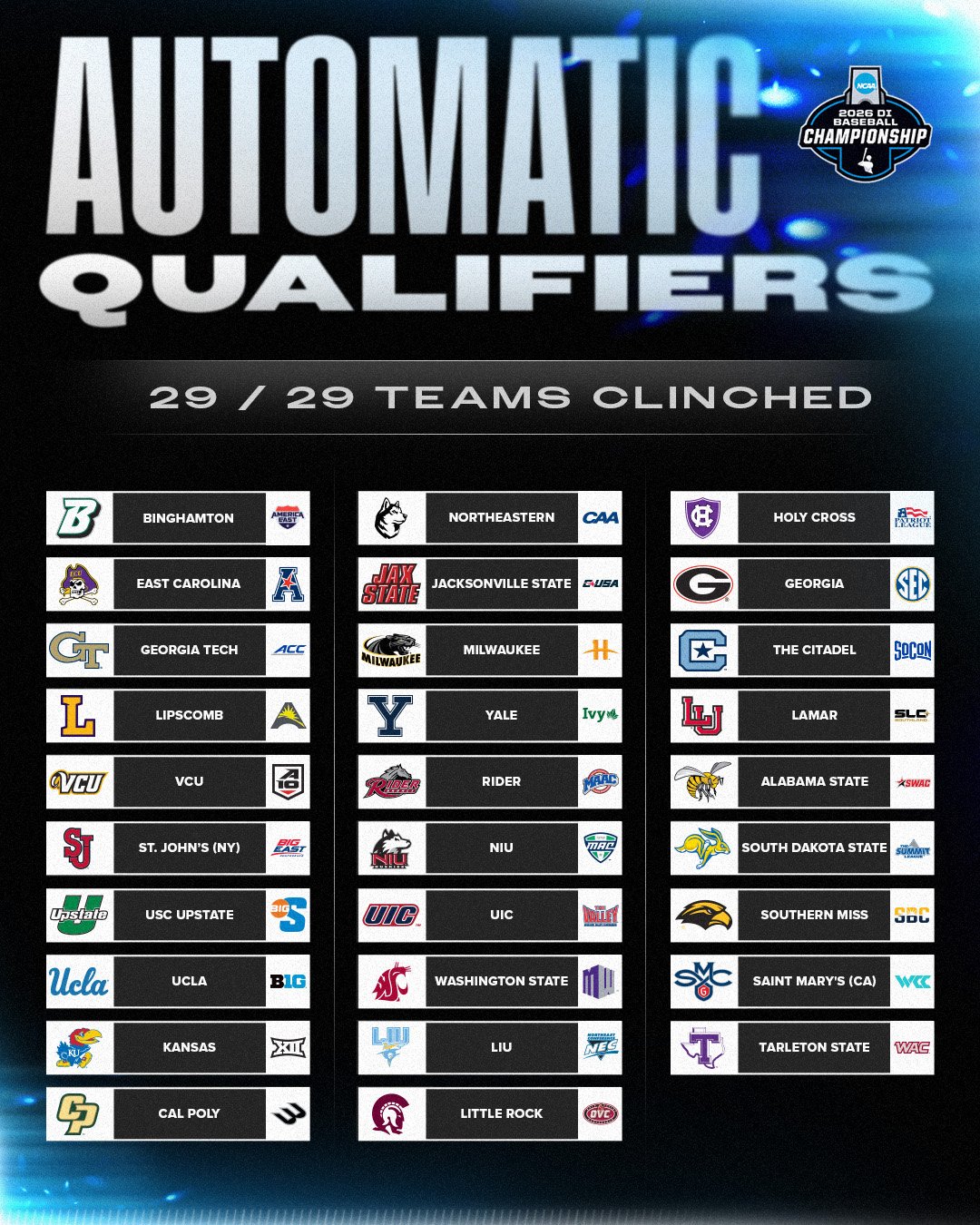
The bubble became crowded quickly, with just one spot vanishing. UTSA abruptly joined the at-large pool after a 1-0 loss to ECU in the American Title Game, despite it being its only loss this week. Incredible that UTSA wound up with a season-ender like that. Otherwise, it wasn’t the full Championship Week caranage that would have taken out profiles like Texas State or Troy that we’ve seen in most seasons.
Noah Bieniek and former Cincinnati and Elon player, JP Sponseller, were gracious enough to have me on the Live reaction show on Sunday night to go over the Host selections and fill out a mutually agreed-upon bracket live. This was a healthy experience and helped me sleep on a few final bubble decisions. Here is the full episode:
HOSTS ANNOUNCED SUNDAY NIGHT
Like many others, I thought Arkansas had done plenty enough to be a host. In previous years, a team’s SEC Tournament run has provided a final path to either hosting a regional, advancing up in the pecking order, or influencing eventual Top 8 designations. The Hogs were excellent this week by beating Tennessee, Texas, and Auburn en route to finishing a strong Second place in Hoover. The run gave Arkansas 18 total Quad 1 wins, a season split with Auburn (2-2) all away from home, and an outstanding 7-5 record against Top 7 RPI teams!
None of it was enough for the committee, which preferred to stick with Mississippi State, Nebraska, and West Virginia. The justification for MSU was the overall RPI edge (13 vs. 21) and slight edges in KPI and DSR. Essentially, Quad 3 and 4 perfection outweighed these direct high-level wins that Arkansas generated. WVU and Nebraska would have been tough to remove from hosting; both had earned it in different ways, but I believed Arkansas was clearly above both on Sunday, before the host announcement. The announcement brought the entire seeding exercise for a final spin. This final Bracketeer projection was more based on RPI + Metrics. Valuing more metrics-based comparisons than Quadrant or H2H results, which seemed to be the main clue from this committee on Sunday.
The TOP 8 went mostly according to plan. Auburn was correctly adjusted to 4th overall after some analysis of Mississippi State's hosting decision and a few similarities to Auburn being 4th overall in 2025. Alabama did claim the 7th overall spot, which was the main slight miss here. I believed committee influence, combined with a few metrics advantages, would’ve pushed Bama down by a couple of spots. This was more of a pleasant surprise. Kansas, as a Top 8, quickly became hopeless by Sunday night due to the nature of Mississippi State hosting instead of Arkansas. It was fairly clear that the Big 12 Title Run wasn’t going to give KU a big enough boost, thanks to its RPI still being at 19th. The initial thinking was that DSR would serve similarly to KenPom in Basketball for KU. The Jayhawks finished 9th in that power-based platform, warranting a Top 8 consideration.
OTHER HOST ORDER leads off with Southern Miss as a 9 overall seed, followed by Florida State. Michael Alford’s status as Chairman of the Selection Committee really gave a shaky FSU resume a high floor. They landed as the 10-seed overall, but likely should have been 13 or 14 based on actual games — the RPI helped here, and we knew that would be the case. The 11-seed surprise went to Oregon, which made me wonder if they wanted to prevent a Texas vs. Texas A&M Super Regional? Really difficult to give Oregon a higher seed than Texas A&M.
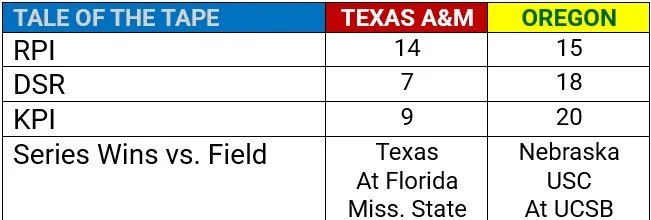
One of those decisions that won’t need a lot of airtime, but does make you wonder as a forecaster. Next, we saw Nebraska, followed by Mississippi State, Kansas, and West Virginia. The only real issue I have is Nebraska over Kansas. Kansas achieved the holy grail of both Big 12 Titles, some revenge on WVU in the Title Game, and mini-swept Nebraska this year. They realistically earned a Top 8 discussion, but were blocked by ADs at Florida, FSU, and Southern Miss from being seriously considered.
Perhaps the most telling part of the Chairman Michael Alford interview was the opening, where he thanked people at ESPN, along with his committee, for getting this bracket to a good place. The ESPN studio team also complimented the bracket several times at the end of the show. It felt complex to me. But this is our reality. Building a bracket for entertainment while allowing room for errors in the seeding and selection process. It would be nice to have this acknowledged, because otherwise, a perfect forecast may prove to be impossible. Last season, I was fortunate to get all 64 and all 16 hosts. I am quickly doubting if I can do it again. Unless there is better transparency.
Here is a look at the initial Host announcement:
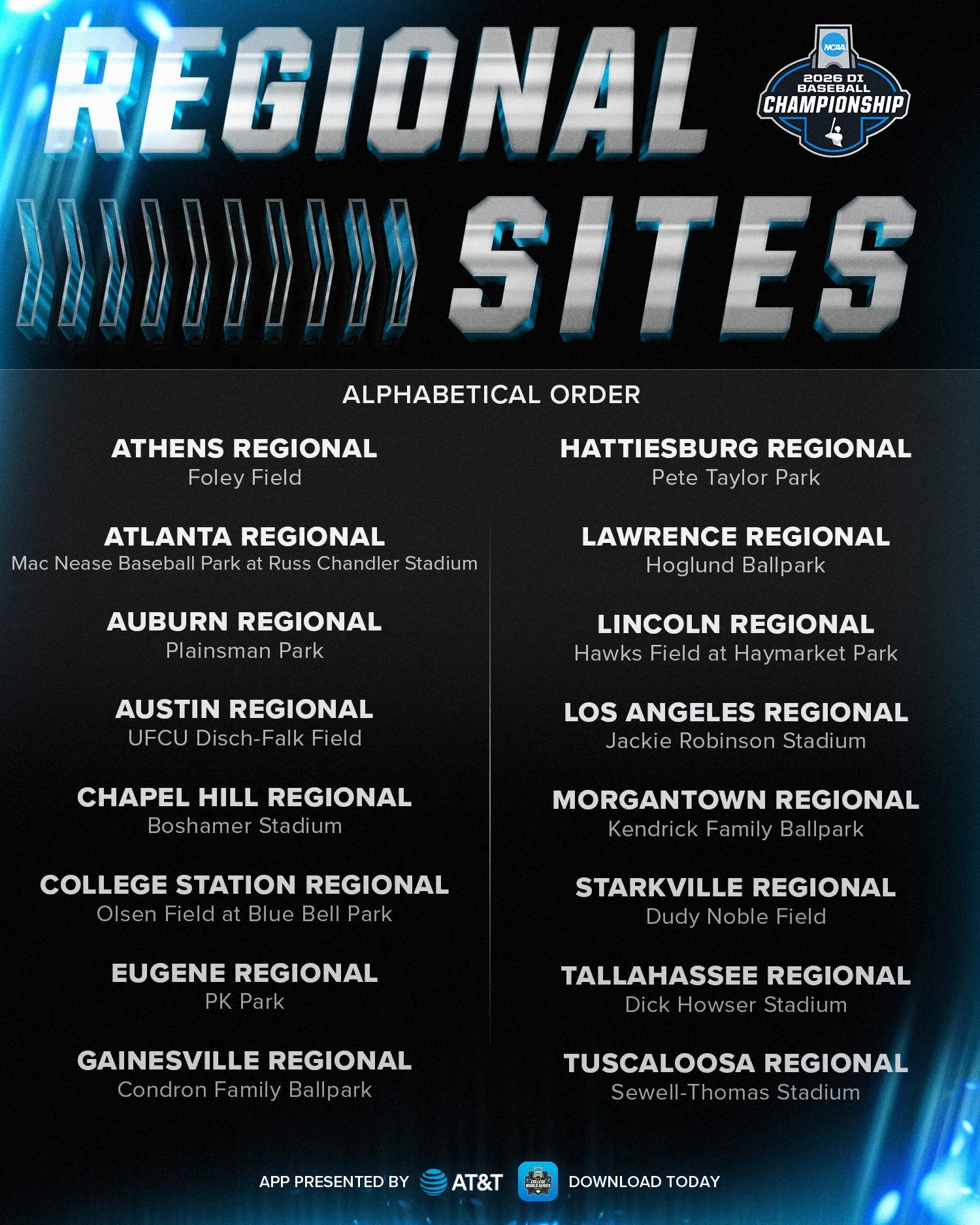
2026 Confirmed Hosts, posted y NCAA on Sunday, May 24th, 2026.
WHAT HAPPENED TO SEEDS 17-32?!
It was written several times and at the beginning of the week that the regional balance regulations would now require 2-seeded squads to be seeded and slotted with corresponding 1-seed teams to create competitive balance. Despite Bracketeer, D1Baseball, Baseball America, and others consistently displaying the 17-32 seeds in brackets, the NCAA did not. Creating deeper skepticism.
Jacksonville State won 46 games and two CUSA titles. JSU was in the Top 25 of RPI and KPI, and should have been a highly rated 2-seed threatening to host. Instead, a 3-seed? Virginia Tech played with the bubble all year, but somehow landed as a 2-seed.
There is a logical rationale to punish teams closer to the bubble by assigning them as teams 29-32, and sending them to the toughest hosts. However, once again, there is zero transparency on this. So the exercise left several teams off the 2-seed line that ultimately got there.
The NCAA never told us the exact order, so we are left with scraps. Actual 17-32 in some order looked like this in the end:
17-20: Arkansas, Ole Miss, Wake Forest, Cincinnati
21-24: USC, Oregon State, Virginia, Coastal Carolina
25-28: Miami, Oklahoma State, UC Santa Barbara, Tennessee
29-32: Boston College, Virginia Tech, UCF, Oklahoma
FINAL BUBBLE CHOICES
The bubble was heavily discussed yesterday on social platforms. As I said, I do feel gutted for UTSA and Mercer for very different rationales.
UTSA was just solid all year and talented. Coming off a Super Regional appearance, and ultimately competed in a tough American Conference that was so balanced that it cannibalized itself. The Roadrunners blitzed teams in non-conference as well and had good enough pitching to make an Omaha run. So, that is just hard to see a team with such a high ceiling not get invited to play.
Mercer was so unique in beating Georgia Tech on the road at the time that it did. The Yellow Jackets are 11-1 since May 2nd, with its only loss at home to Mercer. The Bears were one of the hottest teams in the country heading into Championship Week, then The Citadel was just hotter - but that is a team that Mercer also beat in a series. The 28th-best RPI gave them plenty of reasons to be chosen. Our forecast predicted that they’d be left out as well, but it didn’t feel good to see it play out.
Texas State became the surprise team on Selection Monday. I thought they were in real trouble as Troy had them out-scheduled by the RPI and out-played in head-to-head, but it’s cool to see them both in the field. It provides a lot of respect to the Sun Belt to reward the league with five bids. The Bobcats split with UTSA on the year and had a stronger schedule, but did not win their conference.
We broke down N.C. State at the beginning of the week, and the Pack ended up getting in with ease. The power of the ACC was too much here. NC State had two mid-week wins over ECU, which was also leveraged as a sweep.
In the end, it proved to be an impossible task to separate Mercer, NC State, TCU, Troy, and UTSA for three spots. Both Mercer and NC State were well behind with poor overall NCSOS rankings. So I was half right there, with Mercer being left out. I took TCU (regrettably) and UTSA (I will own this; they are really good at baseball), along with Troy (yes!).
Here it is
THE FINAL FORECAST
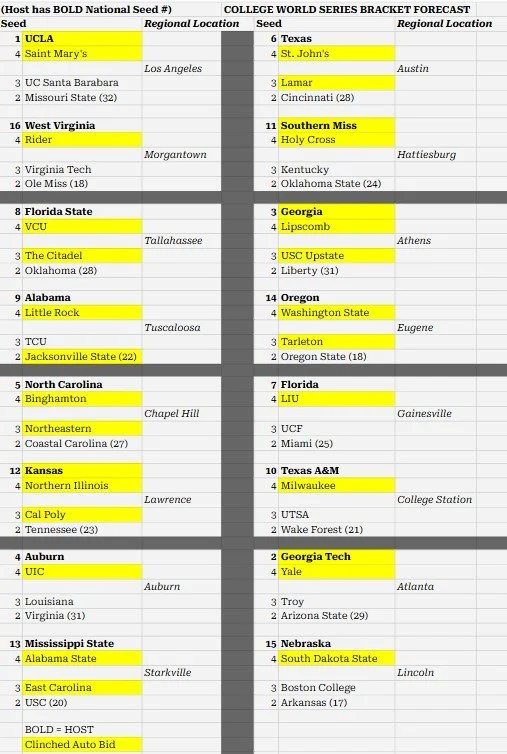
LAST TEAMS IN
Kentucky
Troy
TCU
UTSA
LEFT OUT OF THE FIELD - STILL REASON FOR HOPE
Mercer
N.C. State
Texas State
Pittsburgh
High Point
Kent State
Michigan
Campbell
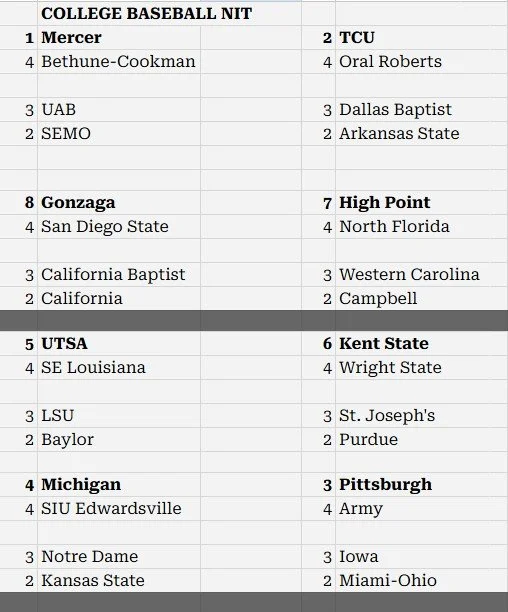
cOLLEGE bASEBALL nIT - fORECAST
If College Baseball had an NIT Tournament, here would be the draw for the 32-Team Field. This was done after seeing the official NCAA Tournament draw.
Format is simple. Conference Champions that did not win the Auto Bid are all invited. Eight Regionals on the opening weekend. The eight winners advance to the NIT World Series.
Thank you for following the special May Baseball forecasting exercises. Back to College Basketball scheduling season!